

Predictive Inspection Guide: How to Detect Hidden Faults in Dust Boots Before They Destroy Your Components
How many times have you stopped a machine due to a breakdown that “didn’t seem to be coming”? In most cases, the warning sign was there. It’s just that no one looked for it in time. Dust boots are one of those components that go unnoticed until they fail, and when they fail, the damage is already done.
In this article, we explain how to apply a true predictive inspection to your dust boots to detect the problem before it becomes a costly breakdown.
Why do dust bellows fail without warning?
Dust bellows work silently. They are compressed and stretched thousands of times a day, enduring splashes of cutting fluid, metal shavings, oil, and dust. They are the first line of defense for your machine’s most sensitive components: spindles, linear guides, and hydraulic rods.
The problem is that their deterioration is gradual and almost invisible to the naked eye if you don’t know what to look for. A small crack, a deformation in the clamping opening, or a loss of rigidity in the folds may seem insignificant. But behind that crack lies a direct entry point for contamination. And contamination, in precision components, is synonymous with accelerated wear and premature failure.
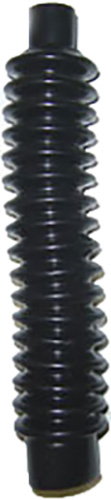
The 5 critical points you should inspect
1. The Bellows Folds
This is the area that accumulates the most mechanical stress. Look for micro-cracks at the base of each fold, especially at the extremes of the maximum and minimum travel. A 2 mm crack today could become a rupture in two weeks.
What to do: Run your finger along each fold with the bellows in the extended position. Any tactile irregularity warrants attention.
2. The Mounting Holes
The holes are the point of connection between the bellows and the machine. This is where the clamping stress is concentrated and where tearing or vibration-induced deformation first appears.
What to do: Check that the holes maintain their original shape. If you observe ovalization, flattening, or loss of contact with the mounting surface, the bellows is no longer sealing correctly.
3. The Rigidity of the Material
The PVC used to manufacture dustproof bellows ages. Over time, exposure to oils, cutting fluids, and temperature causes the material to lose elasticity. A bellows that should fully recover its shape doesn’t: this indicates material aging.
What to do: Manually compress the bellows and observe if it returns to its position cleanly and evenly. If it remains deformed or is slow to return, the material is fatigued.
4. Actual Working Length
Each bellows dust cover is designed to operate between a minimum retracted length and a maximum extended length. When the machine exceeds these limits due to improper adjustment or a change in travel, the bellows is subjected to excessive strain, and its lifespan is drastically reduced.
What to do: Measure the actual working length while the machine is running and compare it to the specifications of the installed bellows. If they don’t match, you have a sizing issue that needs to be corrected.
5. Accumulation of Debris Inside
A bellows that doesn’t seal properly accumulates shavings, dust, and fluids inside. This debris acts as an abrasive on the components it protects and also accelerates the bellows’ own deterioration from within.
What to do: Open or remove the bellows during scheduled maintenance and inspect the interior. The presence of residue is a direct sign of loss of watertightness.
The most common mistake
Waiting until the bellows visibly fails before replacing it. By then, the damage to the protected components has been accumulating for weeks. The cost of a dust bellows is minimal compared to repairing a contaminated spindle or linear guide.
What you need to know before ordering a replacement
To ensure the correct replacement, you need to be clear about: the external stress it endures, the internal dimensions and shape of the openings, the maximum working length, and the minimum retracted length. With this information, you can select the exact dust bellows your machine needs.
Conclusion
Dust bellows are not a secondary component. They are the active protection of the most critical elements of your machinery. Inspect, measure, and replace them promptly. Your machine will thank you.