

Requesting a quote for an industrial bellows without understanding certain technical vocabulary often leads to a series of misunderstandings: incomplete specifications, quotes that don’t match the actual need, or parts that arrive and don’t fit the work environment.
You don’t need to be a materials engineer to request a quote correctly. But knowing these 12 terms certainly helps, because they are precisely what makes the difference between a part that lasts for years and one that fails after just a few months.
1. Maximum opening
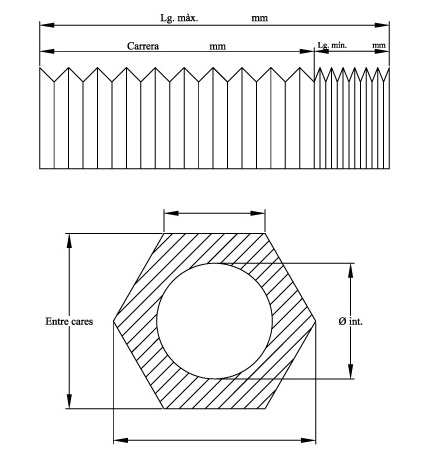
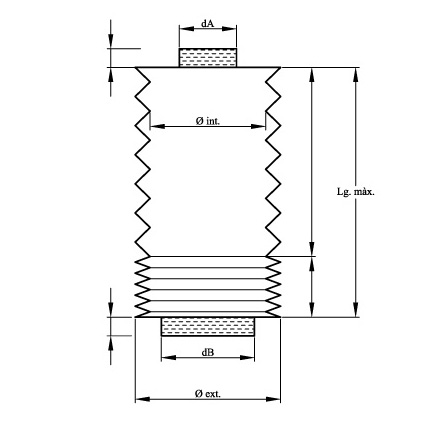
This is the maximum distance the bellows must cover when fully extended. Incorrectly defining this is one of the most common mistakes: an underestimated opening leaves areas of the component unprotected right at the point of maximum travel.
2. Controlled folding
This refers to how the bellows compacts upon itself when retracted. Good controlled folding prevents the material from accumulating unevenly, which can eventually lead to tears in the folds. This is one of the reasons why, in non-linear movements, covers or compensators are used instead of a conventional bellows.
3. Technical fabric
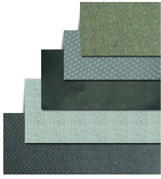
The base material of many bellows is not just any fabric, but a specific combination of fibers and coatings designed to resist abrasion, temperature, or chemical agents depending on the environment. Requesting a quote without specifying the working environment forces the manufacturer to assume a generic fabric, which is not always the most suitable.
4. Tanning (chrome or tannin)
When working with industrial technical leather, the type of tanning determines the performance of the piece. Chrome tanning offers greater resistance to temperature and abrasion; tannin tanning has lower tensile elongation, which gives it greater dimensional stability under sustained load.

5. Coefficient of friction
This indicates how much resistance the material generates when rubbing against another surface. A low coefficient of friction translates to less heat generation, greater efficiency, and a longer lifespan for the part, which is especially relevant for gaskets and seals.
6. Abrasion resistance
This is the material’s ability to withstand constant friction without wearing down. In environments with chips, sludge, or fine particles, this factor is as important as, or even more important than, temperature resistance.
7. Corrosive environment
Not all aggressive environments are aggressive for the same reason. A corrosive environment (such as a wastewater treatment plant, with the presence of H₂S) requires specific materials and reinforced joints, different from those needed in a simply abrasive or hot environment.
8. Linear vs. nonlinear motion
A conventional bellows is designed for linear motion. When the part moves irregularly or along multiple axes, this limitation becomes a problem, and that’s where sleeves, sleeves, or compensators are usually the most suitable option.
9. Vibration absorption
Some protective elements, such as shock absorbers, not only cover the component but also dampen the machine’s vibrations. If your application generates constant vibration, it’s advisable to explicitly ask if the part is designed to absorb it, not just protect it.
10. Machining tolerance
This is the allowable clearance between metal parts. Some materials, such as technical leather, allow for greater machining tolerances without compromising their watertight seal, which can simplify the design of the part they will protect
11. Custom vs. standard parts
A standard part reduces the initial cost but doesn’t always meet the actual installation conditions. A custom part has a slightly higher initial cost, but its full lifecycle usually offsets this difference in demanding environments.
12. Downtime
This term isn’t exclusive to bellows, but it should be considered in any purchasing decision. The true cost of a part isn’t just the purchase price; it’s also the cost of every hour of machine downtime if that part fails prematurely.
Why mastering this vocabulary saves time (and money):
When a purchasing manager includes these terms in their request for quotation, the manufacturer can propose the correct solution the first time, without assuming unrealistic working conditions. The result is a more accurate quote, a better-fitting part, and, above all, fewer surprises after installation.
If you’re unsure which of these terms applies to your situation, the most efficient approach is to describe the actual working environment (temperature, agents present, type of movement) and let the manufacturer translate those conditions into a technical specification.
Do you need a quote for a custom bellows, cover, or compensator? Tell us about your installation conditions, and we’ll help you define the right solution.