

A CNC machine can have a perfectly calibrated spindle, up-to-date numerical control, and cutting tools in optimal condition. And yet, it can still lose accuracy. The source of the problem, in many cases, isn’t the electronics or the software. It’s the bed guides.
What are bed guides and why are they critical?
Bed guides are the elements on which the machine carriages move along the X, Y, and Z axes. The repeatability of the movement depends on their flatness and the absence of play. Any deviation at this point directly impacts the final machining.
Unlike other components, wear on the guides isn’t always visible to the naked eye. The machine continues to operate. It continues to produce parts. But the dimensional tolerance is silently degrading, piece by piece.
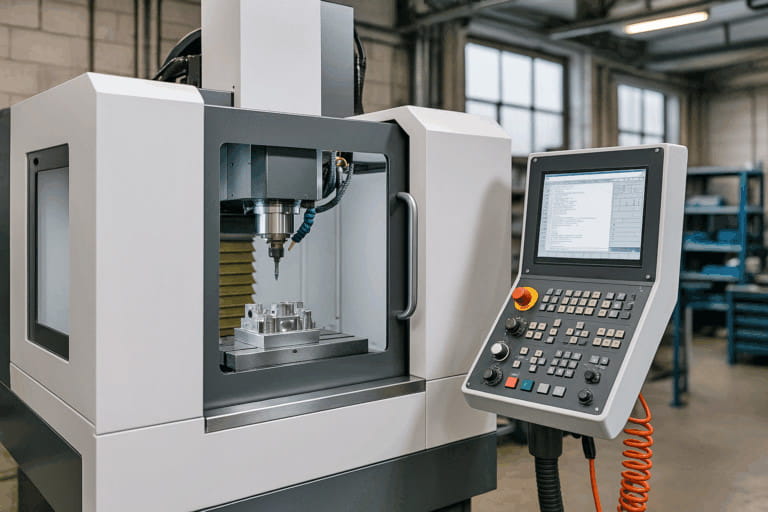
The three enemies of a bench guide
- Metal shavings: abrasive particles that settle on the sliding surface and act like sandpaper on each pass of the carriage
- Coolant and coolant: in addition to promoting corrosion, they drag residues towards the contact areas
- Dust and suspended particles: especially critical in water or laser cutting processes, where the material generated during machining remains floating in the work environment
None of these three elements are avoidable in a machining environment. The question is not how to eliminate them, but how to prevent them from reaching the guide.
From contamination to loss of tolerance: the real chain of change
The degradation process almost always follows the same sequence:
1. The abrasive particle is deposited on the exposed guide.
2. The carriage moves and drags the particle, generating micro-scratches on the surface.
3. The micro-scratches alter the fit between the guide and carriage, introducing play.
4. The play results in vibration during machining.
5. The vibration results in a loss of dimensional tolerance in the final part.
When a workshop begins to detect intermittent out-of-tolerance parts, without any change in the tool or the program, this chain of changes is usually the explanation.
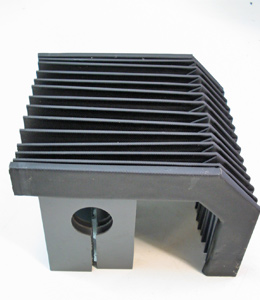
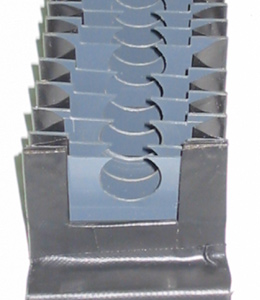
Protection as a technical specification, not an accessory
A bed guide bellows is not a decorative element or an optional add-on. It is a physical barrier designed to prevent chips, coolant, and particles from reaching the sliding surface, maintaining the original fit between the guide and carriage throughout the machine’s lifespan.
For this protection to fulfill its function, it must meet several technical requirements:
● Seal against cutting fluid, without absorption or material degradation from prolonged contact
● Abrasion resistance on the chip-exposed face
● Fatigue-free folding, capable of withstanding the full stroke of the spindle without losing its geometry after thousands of cycles
● Precise dimensional fit to the stroke and bed profile, preventing gaps through which particles can enter
An improperly sized protection, even if present, does not solve the problem. The issue lies not only in having or not having a bellows, but also in ensuring that the bellows are custom-made for the machine’s stroke and actual working environment.
Preventive maintenance: The other half of the equation
Protection reduces exposure, but doesn’t eliminate it entirely. That’s why it’s advisable to combine it with a routine inspection:
● Visually inspect the condition of the bellows at each scheduled stop
● Check for perforations or wear areas in the folds
● Verify that the fit to the carriage remains airtight after disassembly for maintenance
Replacing a worn bellows before it fails is considerably more economical than restoring the lost accuracy of a bed, or worse, than reconditioning it.
Conclusion
The accuracy of a CNC machine doesn’t depend solely on its control electronics. It also depends on the mechanical elements that support the movement, such as the bedways, remaining free of contamination throughout their service life. A well-specified guard, designed specifically for the travel and the working environment, is the difference between a machine that maintains its tolerance year after year and one that loses it piece by piece without anyone noticing in time.