
In the fields of automation and machining, the choice of protective element determines the overall reliability of the equipment. Each machine operates under distinct kinematic, geometric, and environmental conditions. Specifying an unsuitable bellows can lead to mechanical stress, vibrations caused by excessive friction, sealing failures, or a loss of dimensional precision in the protected components.
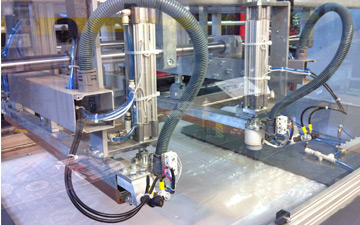
Catalog of industrial bellows by machine type
1. Bellows for linear guides
Designed for flat, linear axial movement along machine beds and guideways.
- Applications: CNC machining centers, cutting tables, and automated lines exposed to coolants, chips, or abrasive dust.
- Recommended materials: Heat-sealed technical PVC, polyurethane, or multilayer fabrics with rigid internal reinforcements.
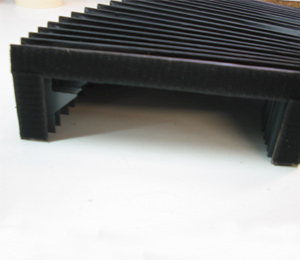
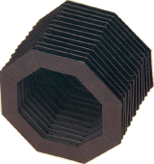
2. Circular bellows (cylindrical or tubular)
Concentric protection for cylindrical components undergoing axial or rotational movement.
- Applications: Ball screws, hydraulic or pneumatic rods, and mechanical columns prone to loss of precision due to contaminant buildup.
- Recommended materials: Elastomeric polymers, high-frequency welded polyurethane, or flexible technical fabrics.
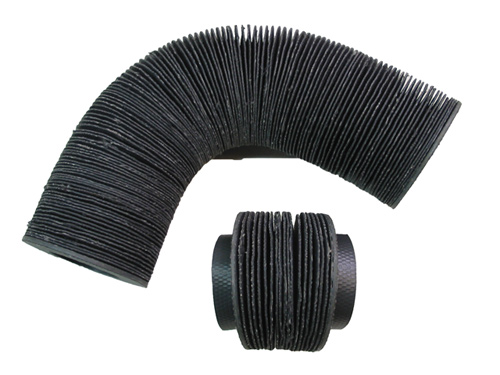
3. Trapezoidal or pyramidal bellows
Asymmetric structures or those with variable cross-sections, adapted for complex kinematics.
- When to use: Specialized machinery, prototypes, or work areas where the housing geometry prevents the use of standard rectangular or circular profiles.
- Recommended materials: High-strength technical fabrics reinforced with internal frameworks.
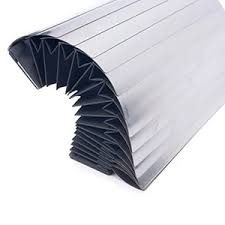
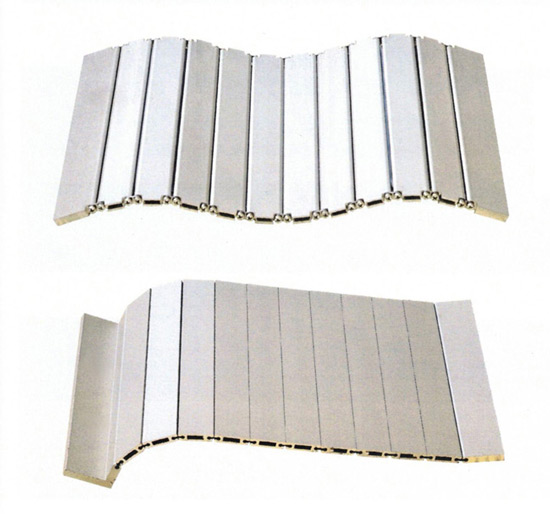
4. Metal bellows and slats
Articulated shielding with high mechanical strength for extreme operating conditions.
- When to use: Environments involving frequent impacts from incandescent chips, continuous exposure to corrosive chemicals, or severe abrasion during 24/7 operations.
- Recommended materials: Stainless steel, treated steel sheets, or articulated aluminum profiles.
5. Flat curtains and guards
Isolation screens designed to cover large openings or perimeter enclosures.
- When to use: Large-format machinery, static zones, or enclosures requiring a barrier against dust, debris, and sparks, where complex folding movement is not needed.
- Recommended materials: Technical fabrics coated with rubber, silicone, or high-density PVC.
Technical criteria for determining the appropriate bellows
- Kinematics and operating envelope: Analyze the movement path (linear, telescopic, or angular) and verify the minimum compression and maximum extension dimensions ($L_{\text{min}} / L_{\text{max}}$).
- Environmental severity: Assess thermal (incandescent chips), chemical (oils, solvents), or mechanical (direct impact) stress levels.
- Drive dynamics: Adjust the weight of the protective cover to prevent overloading servomotors or reducing the speed of the robot or axis.
The Lluis Creus Response: Tailored Smart Protection Solutions
At Lluis Creus, we develop protective components adapted to the exact geometry and kinematic requirements of each machine. With a 150-year track record in the industrial sector, we support every project with a personalized engineering approach:
- Design adapted to complex geometries: We manufacture linear, circular, and conical bellows, as well as those with special shapes, ensuring a perfect fit on guideways without dynamic interference.
- Technical material selection: We offer a wide range of technical textiles, elastomers, high-resistance coatings, and metal solutions to suit any operating environment.
- Waterjet cutting: We produce frames, flanges, and mounting plates to strict tolerances, ensuring precise, leak-proof assembly.
- ISO 9001:2015 certified quality: Standardized manufacturing processes ensure durability, repeatability, and rapid replacement.
If you need assistance defining the ideal bellows for your equipment or production lines, Lluis Creus develops the custom technical solution to maximize your machinery’s uptime.