

Ordering “an industrial bellows” without specifying the working environment is like ordering “boots” without saying whether you’re going to the snow, the desert, or an operating room. The right material changes completely depending on the actual conditions of the installation, and choosing the wrong one isn’t noticeable on day one: it becomes apparent six months later, with a breakdown that “wasn’t foreseen.”
In this article, we explore three of the most demanding environments in industrial maintenance and what characteristics a custom-made bellows should have in each of them.
Why environment matters more than function
A bellows, a sleeve, or a compensator always fulfills the same basic mission: to protect a moving component from dirt, abrasion, or direct contact with an aggressive agent. But the “how” of that protection depends on very specific variables:
● Continuous and peak operating temperature.
● Presence of chemical or corrosive agents.
● Exposure to fine particles, sludge, or swarf.
● Environmental cleanliness and hygiene requirements.
● Movement of the part (linear or nonlinear) and cycle frequency.
When any of these variables is ignored during the specification phase, the usual result is premature failure of the joints, loss of sealing, or accelerated material degradation. Let’s see what each environment demands.
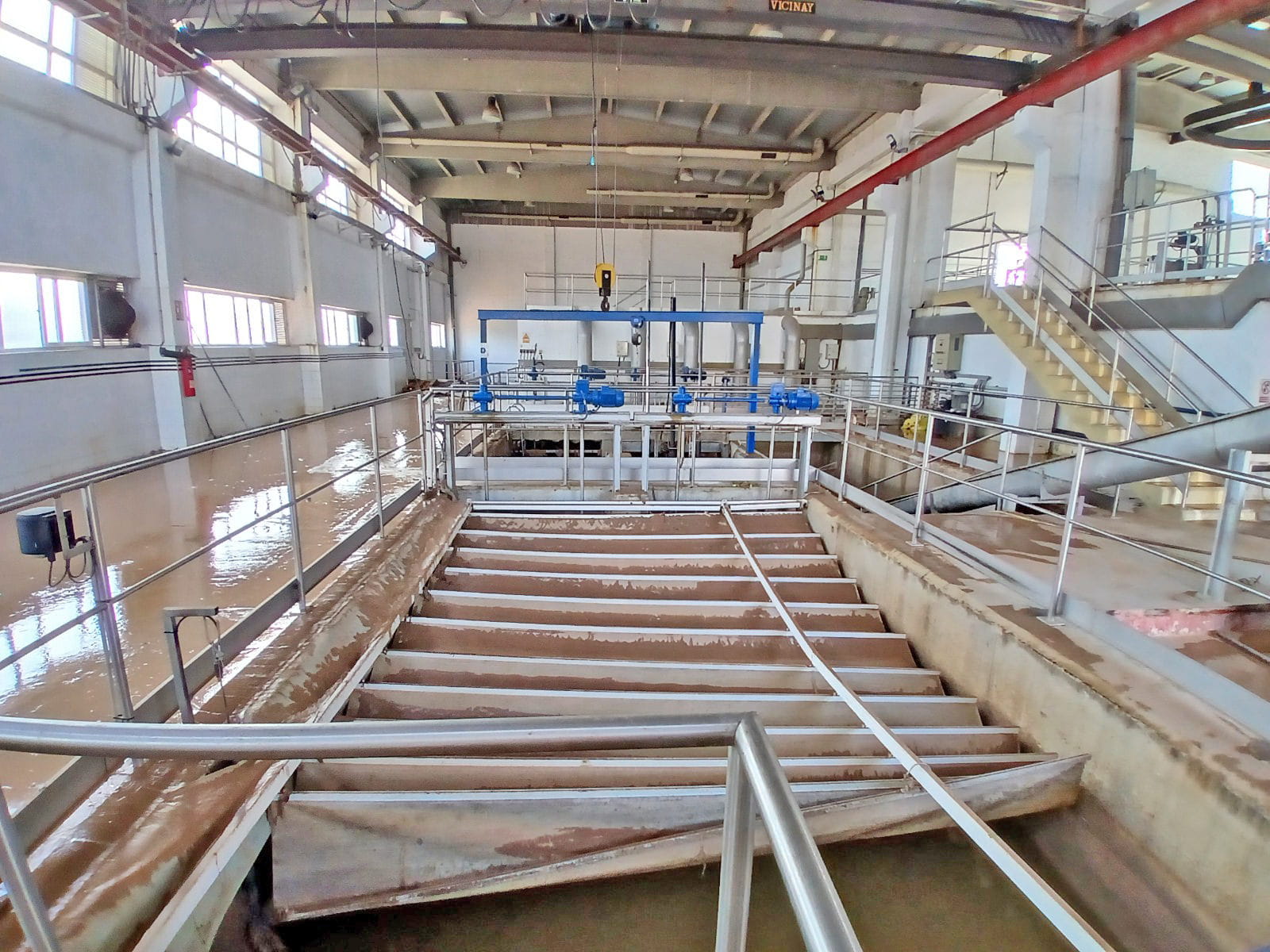
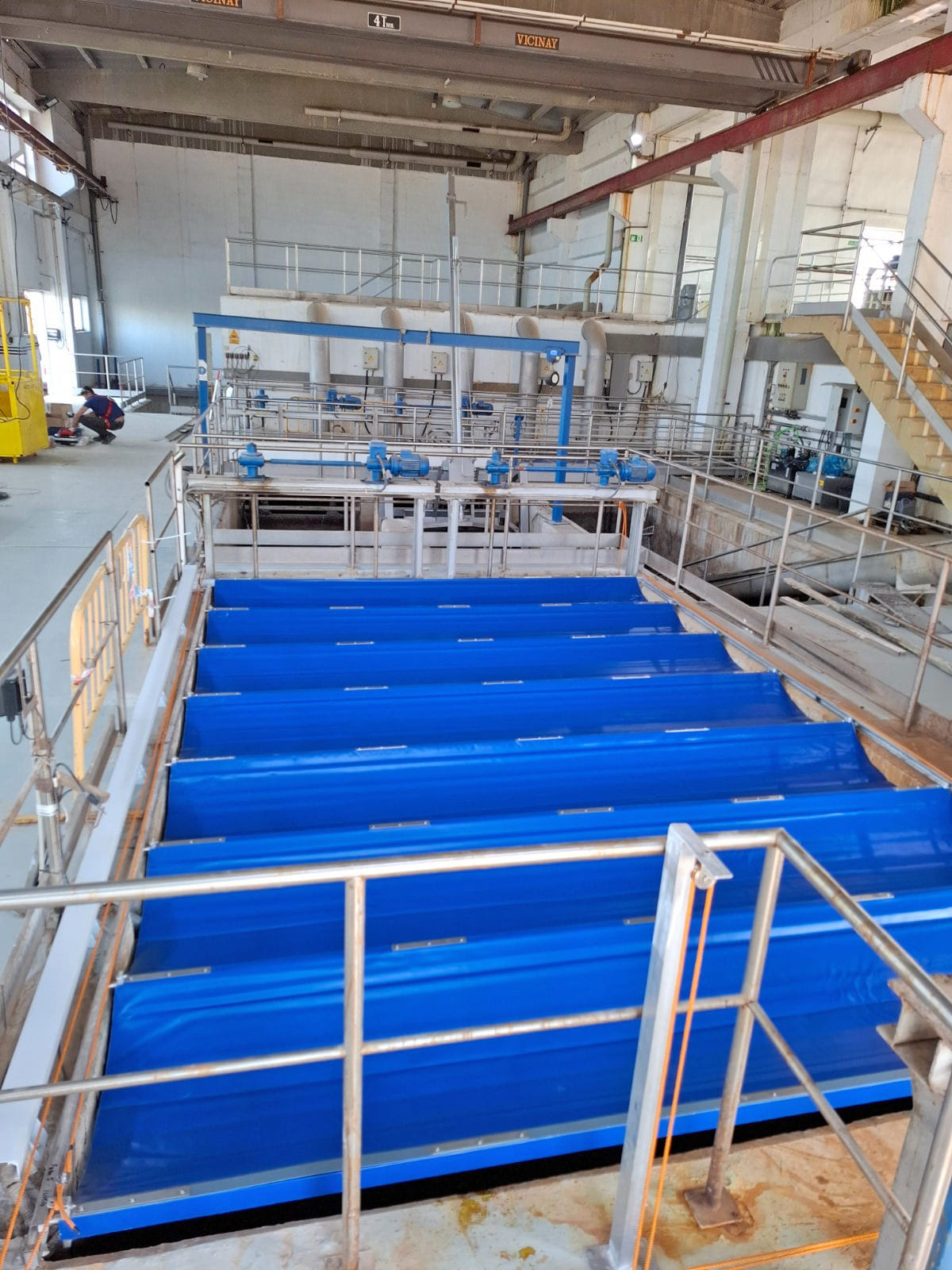
Wastewater treatment plant (WWTP): corrosion, abrasive sludge, and submerged operation
In a wastewater treatment plant, the WWTP bellows operates under conditions that few industrial components can withstand: partially or fully submerged, exposed to H₂S and other corrosive agents, and in constant contact with abrasive sludge that particularly damages joints and seams.
Here, the material must prioritize:
● Chemical resistance to hydrogen sulfide and corrosive compounds inherent in water treatment.
● Reinforced joints, since the joint point is usually the first to fail under constant vibration and abrasion.
● Stability under permanent humidity, without loss of flexibility or degradation of the technical fabric.
A bellows designed for a dry environment, installed in a grit chamber or coarse sediment tank, fails much sooner than expected. This is not a product quality issue, but a specification issue.
Solar thermal power plants at 200°C: The material that can’t succumb to heat
In a solar thermal power plant, the protection of cylinders and moving components operates with temperature peaks that would render most standard technical fabrics unusable. We’re not talking about occasional heat resistance here, but continuous operation at 200°C without losing mechanical properties.
Key requirements:
● Continuous thermal stability, without embrittlement or loss of elasticity after repeated heat cycles.
● Resistance to direct solar radiation, which degrades materials not designed for prolonged UV exposure.
● Compatibility with the large-amplitude movements common in solar tracking of the cylinders.
In this type of installation, chrome-tanned leather, with its superior temperature resistance, is often a viable alternative to conventional technical fabrics, depending on the specific installation location and the type of protection required.
Cleanroom: invisible dirt matters too
At the opposite end of the spectrum is the cleanroom. Here, the challenge isn’t corrosion or heat, but particle generation. A cleanroom bellows must not only protect the component; it cannot itself become a source of contamination.
What’s prioritized in this environment:
● Low-particle-generation materials, certified to ensure they don’t compromise the cleanroom’s classification.
● Finishes without loose fibers or coatings that peel off with friction.
● Ease of cleaning and disinfection, without the material degrading under standard industry protocols (pharmaceutical, electronics, food). Here, the selection criteria are reversed compared to wastewater treatment plants or solar thermal power plants: it’s not about withstanding an aggressive environment, but about not harming the environment itself.
The conclusion: there is no such thing as a “universal bellows.”
These three cases illustrate something that in industrial maintenance is almost always learned through failure: the correct material depends on the actual working environment, not on the generic function of the part. A wastewater treatment plant bellows, a solar thermal power plant bellows, and a cleanroom bellows may have the same shape and purpose on paper, but they share very little in terms of material, assembly, and finish.
Before requesting a quote for a bellows, it’s worth thoroughly documenting the actual conditions of the installation: temperature, chemical agents present, type of particles, and cleaning requirements. This information allows for the manufacture of custom-made machinery protection that lasts as long as it needs to, not half as long.
Does your facility operate in an unusual environment? Tell us about the conditions, and we’ll help you determine the right material.