

The choice of material for an industrial bellows is a decision that directly impacts the durability, efficiency, and reliability of machinery. Although often considered a secondary component, the material of the bellows determines its ability to withstand abrasion, chemicals, temperature, movement speed, and operating cycles. An error in this selection can lead to premature wear, loss of sealing, failures in linear guides and actuators, and unscheduled downtime.
This article provides a comprehensive technical guide for engineers tasked with selecting the appropriate material for industrial bellows, based on physical properties, environmental compatibility, and selection criteria applicable to modern machinery.
1. Why bellows material is critical in engineering
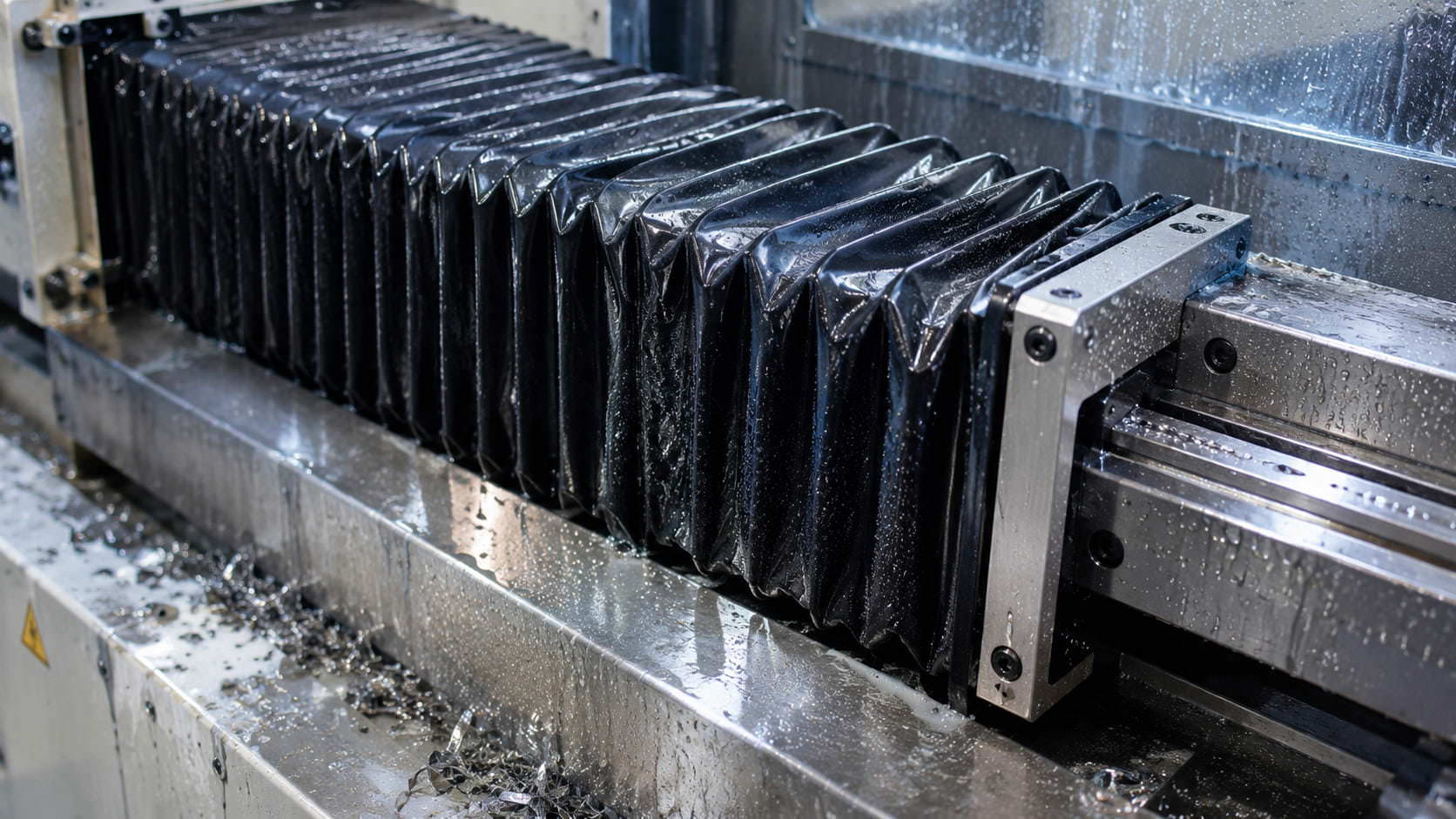
Industrial bellows serve an essential function: protecting moving components from contamination, abrasion, chemicals, moisture, and temperature extremes. For this protection to be effective, the material must respond appropriately to the environmental conditions.
An improperly selected bellows can lead to:
● loss of precision in linear guides,
● accelerated wear in actuators,
● deformation due to temperature,
● fatigue-related fractures,
● ingress of debris (such as metal chips) or dust,
● failures in lubrication systems.
Therefore, the selection of the material should not be based solely on cost or availability, but rather on a technical analysis of the environment and the type of movement involved.
2. Physical properties that determine material performance
Before evaluating specific materials, it is essential to understand the physical properties that influence their behavior:
Mechanical strength
The material’s ability to withstand impacts, abrasion, and pressure without deforming.
Flexibility
Essential for bellows subjected to repetitive or multidirectional movements.
Chemical resistance
Crucial in environments involving coolants, oils, solvents, or aggressive particles.
Thermal stability
The material must maintain its shape and properties at high or fluctuating temperatures.
Impermeability
Prevents the ingress of liquids, dust, and particles into critical areas.
Cyclic fatigue
Indicates how many movement cycles the material can withstand without degrading.
3. Materials most commonly used in industrial bellows and their applications
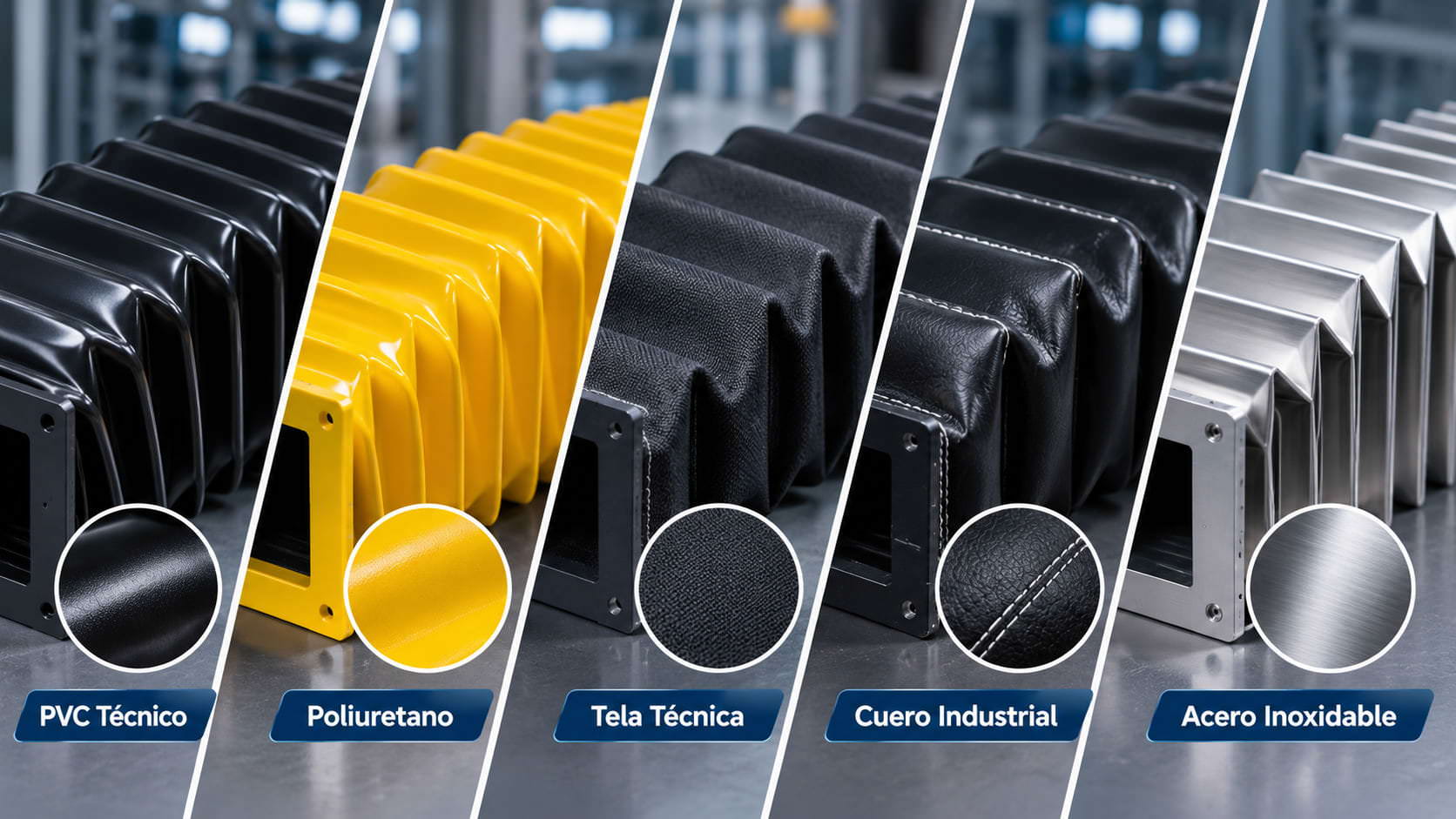
Below is a technical analysis of the materials most frequently used in the manufacture of industrial bellows.
Technical PVC
Application: standard machinery, environments with oil and dust.
Advantages:
- good chemical resistance,
- low cost,
- moderate flexibility,
suitable for linear movements.
- Limitations:
- not suitable for high temperatures,
- lower resistance to extreme abrasion..
Polyurethane
Application: rapid and repetitive movements.
Advantages:
- excellent elasticity,
- high mechanical strength,
good shape recovery.
- Limitations:
- lower resistance to aggressive chemicals,
- not recommended for contact with hot metal chip.
Technical fabrics
Application: harsh environments involving abrasion, heat, or chemicals..
Advantages:
- abrasion-resistant,
- flame-retardant,
- waterproof,
- multilayered,
high thermal stability.
- Limitations:
- require specialized manufacturing,
- higher cost.
Industrial leather
Application: traditional machinery, restoration, artisanal applications.
Advantages:
- aesthetic appeal,
- natural durability,
good flexibility.
- Limitations:
- low chemical resistance,
- not suitable for high temperatures.
Stainless steel
Application: extreme environments involving heat, abrasion, or chemicals.
Advantages:
- maximum resistance,
- thermal stability,
superior durability.
- Limitations:
- lower flexibility,
- higher cost,
- requires specific design.
4. Technical comparison of materials
A comparison table helps visualize the key differences:
| Material | Mechanical strength | Flexibility | Chemical resistance | Temperature | Recommended environment |
| PVC | Medium | Medium | High | Medium | Standard machinery |
| Polyurethane | High | Very high | Medium | Medium | Rapid movements |
| Technical fabric | Very high | High | High | High | Aggressive environments |
| Leather | Medium | High | Low | Low | Conventional machinery |
| Stainless steel | Very high | Low | Very high | Very high | Extreme environments |
5. How to choose the right material: A guide for engineers
Material selection should be based on a technical analysis of the environment and the type of movement. A practical guide is provided below:
1. Evaluate the environmental temperature
- Hot chips or extreme heat: stainless steel or technical fabrics.
- Moderate temperature: PVC or polyurethane.
2. Analyze the type of movement
- Rapid, repetitive movements: polyurethane.
- Standard linear movements: technical-grade PVC.
- Multidirectional movements: technical fabrics or specialized bellows.
3. Consider the presence of chemicals
- Aggressive coolants: stainless steel or technical fabrics.
- Standard oils: technical-grade PVC.
4. Review the available space
The machine’s geometry determines whether folded bellows, curtains, or custom solutions should be used.
5. Evaluate duty cycles
For machines operating 24/7, reinforced materials and multi-layer fabrics are recommended.
Selecting the material for an industrial bellows is a strategic decision that directly impacts the precision, durability, and reliability of machinery. A well-chosen material ensures effective protection, reduces failures, minimizes maintenance, and extends the service life of critical components. For engineers, understanding the properties of each material and how it performs in various environments is essential for designing truly efficient protective solutions.