

Industrial robots are complex systems designed to perform precise, repetitive movements. However, their mechanical architecture makes them vulnerable to contamination, abrasion, and chemicals present in industrial environments. Protecting them is essential to ensure accuracy, stability and long life.
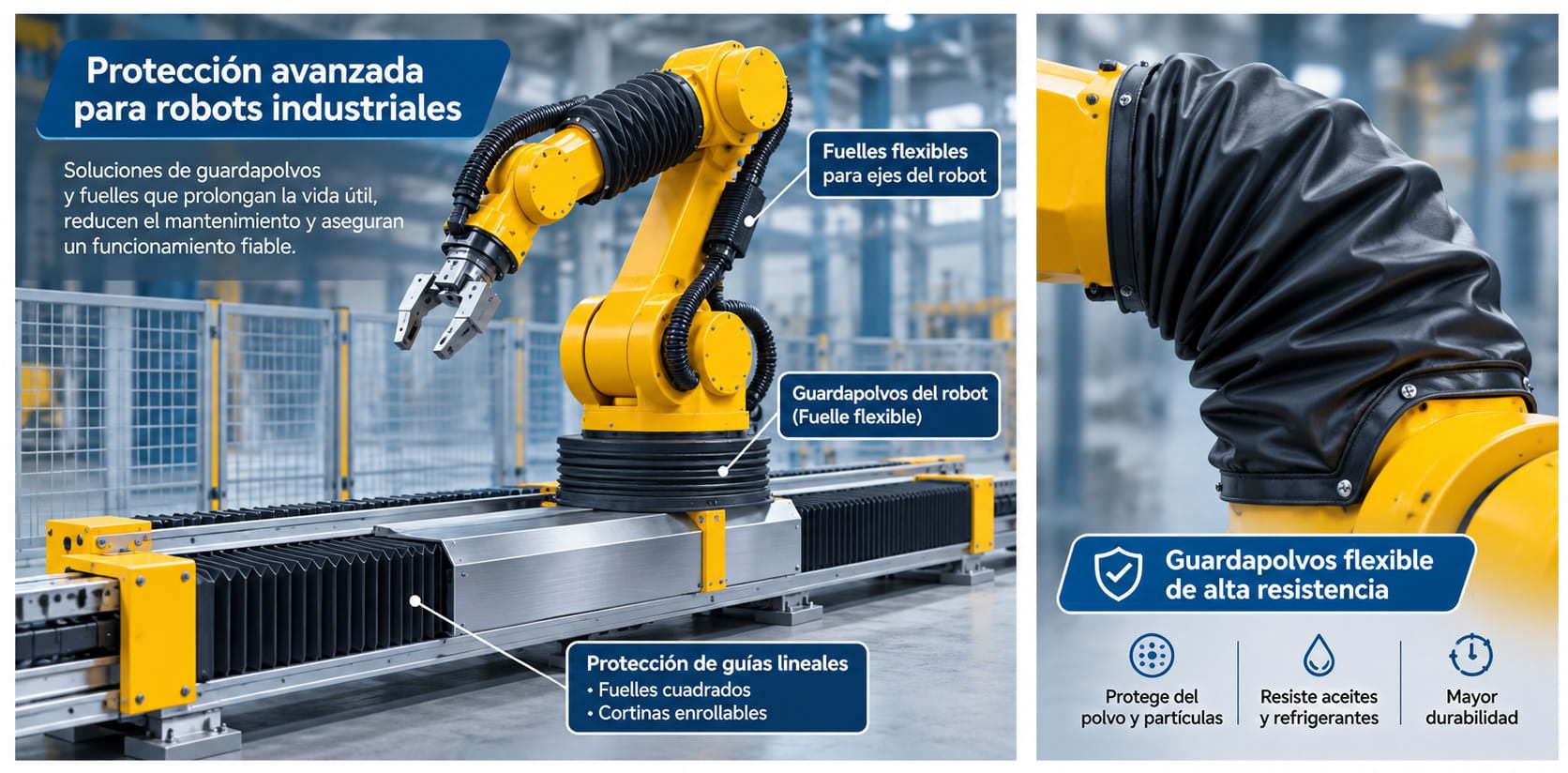
Robot architecture: how it is built and where it is prone to degradation
To design effective protection, it is necessary to understand the robot’s structure:
Joints
These are the most exposed points. Contamination can alter friction and cause deviations in the robot’s path.
Actuators
Hydraulic and pneumatic actuators can suffer from leaks, loss of pressure, and wear caused by particles.
Cabling and sensors
Exposed cables can be damaged by abrasion or chemicals, affecting the robot’s precision.
Vulnerable points by robot type
6-axis robots
Their rotary joints require flexible bellows that do not restrict movement.
SCARA robots
Their vertical and horizontal axes need protection against dust and debris (shavings).
Cartesian robots
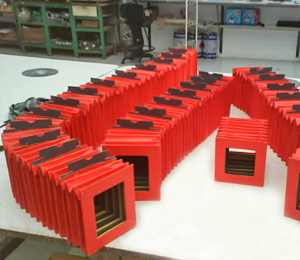
Linear guides must be protected using square bellows or roll-up covers.
Collaborative robots
Although they operate in cleaner environments, they require protection to prevent wear caused by repetitive motion.
Recommended protection solutions
Flexible bellows
Adapt to the robot’s kinematics without creating resistance.
Protective covers for actuators
Prevent the ingress of dust, metal shavings, and chemicals.
Specialized bellows
Custom-designed for robots with a wide range of motion or unconventional joints.
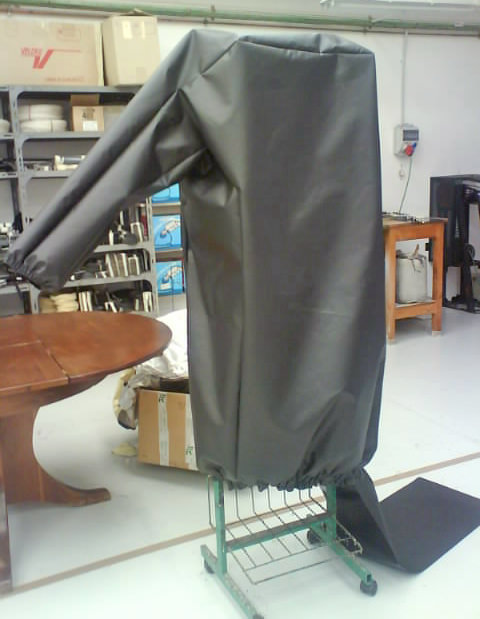
Chemically resistant technical fabrics
Ideal for environments involving coolants, oils, or metallic particles.
Integration recommendations
- Integrate protection from the design phase
- Select materials with high flexibility
- Protect cables and sensors using specialized bellows
- Verify chemical compatibility
- Implement sensor-based predictive maintenance
Conclusion
Proper protection enables a robot to maintain its performance, even in harsh environments. It is a key investment for any automated line that prioritizes reliability and precision.