

Requesting a quote for a circular bellows without the correct measurements is the most common cause of maintenance delays. The part arrives, doesn’t fit, and the purchasing process starts all over again. With a proper measuring procedure, this error is avoided in most cases.
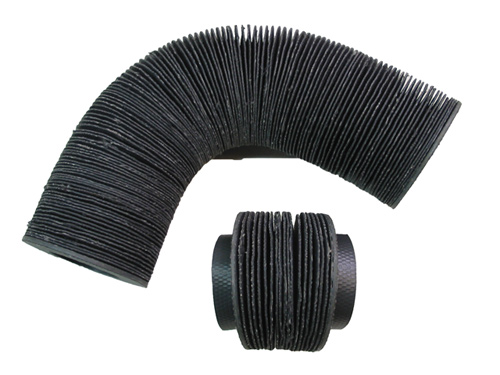
Before measuring: Identify the type of circular bellows
Not all circular bellows are measured the same way. Before picking up your measuring tape, it’s helpful to know if the bellows is:
● Cylindrical, with a constant diameter along its entire length
● Conical, with a larger diameter at one end and a smaller diameter at the other
● With mounting flanges, where the mounting diameter differs from the diameter of the bellows itself
This distinction determines how many diameter measurements you need to take and at what exact points.
Step 1: Measure the larger outside diameter
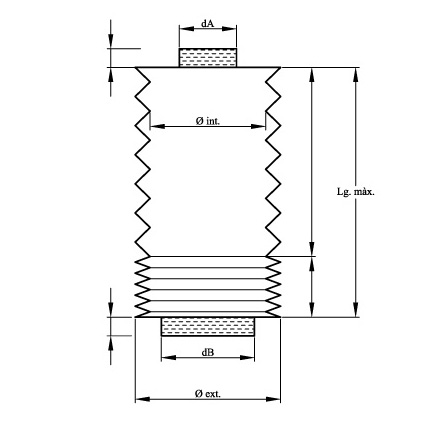
With the bellows in its extended position, measure the outside diameter at its widest point. If the bellows is conical, this will be one of the two ends; if it is cylindrical, the diameter will be constant along the entire length.
Use calipers or a flexible measuring tape fitted to the contour, never a straight ruler on a curved surface, as this introduces measurement error.
Step 2: Measure the smaller outside diameter
If the bellows is conical, repeat the measurement at the opposite end. If it is cylindrical, this step is omitted because the diameter is the same at both ends.
Step 3: Measure the inside diameter at both ends
The inside diameter determines the clearance for the shaft or rod that the bellows will protect. Measure at both the larger and smaller ends, even for cylindrical bellows, as some models have varying wall thicknesses.
Step 4: Measure the length in the extended position
With the bellows fully extended, measure the distance between its two ends. This measurement marks the maximum stroke the bellows can cover.
Step 5: Measure the length in the compressed position
Fold the bellows to its maximum compression position and measure the distance between the ends again. This measurement indicates the minimum space the bellows will occupy when the shaft is fully retracted, a critical piece of information if the housing space is limited.
Step 6: Count the number of folds.
Count the complete folds of the bellows. This data, combined with the extended and compressed lengths, allows for reproducing the exact geometry of the replacement part and prevents the manufacturer from having to estimate the folding pitch.
Step 7: Identify the fastening system at each end
Note whether the bellows is fixed by:
● Bolted flange
● Clamping ring
● Direct gluing or vulcanization to a support.
The fastening system is not always interchangeable between manufacturers, and a replacement part with the correct geometry but the incorrect fastening creates the same problem as an incorrect measurement.
Step 8: Identify the material and working environment
Along with the measurements, indicate the environment where the bellows operates: service temperature, exposure to coolant, oils, chemicals, or UV radiation if it is outdoors. The replacement material should be selected based on this environment, not just the geometry.
Summary of data to be included in the order:
- Largest outer diameter
2. Smallest outer diameter (if conical)
3. Inner diameter at both ends
4. Extended length
5. Compressed length
6. Number of folds
7. Fixing system at each end
8. Current working environment and material, if known

Conclusion
Measuring a circular bellows doesn’t require complex tools, but it does require a clear order: first the diameters, then the lengths at both ends, and finally the fixing and environment data. Including these eight pieces of information in the order virtually eliminates the margin of error and prevents the cycle of incorrect quotes that delays maintenance.