

In industrial robotics, equipment protection is closely linked to overall plant performance. Every axis, rotation, and movement takes place in demanding environments exposed to dust, metal chips, coolants, abrasives, or chemicals. When robotic cells operate on a 24/7 basis, the accumulation of contaminants gradually degrades the precision, repeatability, and service life of mechanical and electronic components.
Robot bellows address this challenge through dynamic sealing solutions. Their primary function is to shield joints, axes, and cabling, ensuring the robot maintains its nominal speed, angle, and trajectory without mechanical interference.
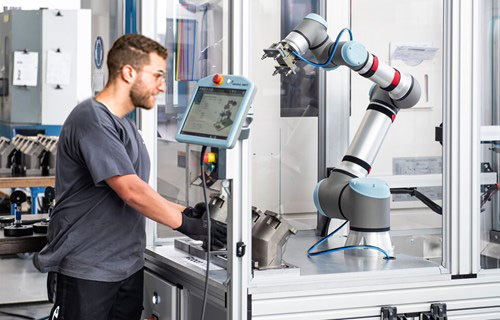
Critical applications of robotic bellows based on the environment
Bellows design and material vary depending on the industrial process to which the automated cell is exposed:
- Welding robots (MIG/MAG, TIG, Laser): Protect power cables, torches, and joints against flying sparks, weld spatter, and radiant heat, preventing burns and insulation failures.
- Machining, milling, and deburring robots: Abrasive chips and cutting fluids attack gearbox seals. The bellows prevent contaminants from penetrating the guides, thereby avoiding unwanted friction and axis vibrations.
- High-speed robots (Pick & Place and Delta): During ultra-fast work cycles, the protective cover must accommodate high accelerations without creating mechanical resistance, overloading servomotors, or suffering material fatigue deformation.
- Robots in paint cells and chemical environments: Exposure to solvents, paint mists, or corrosive vapors requires technical fabrics with elastomeric coatings that prevent chemical degradation.
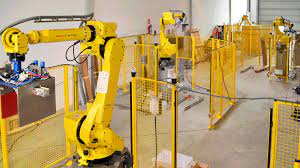
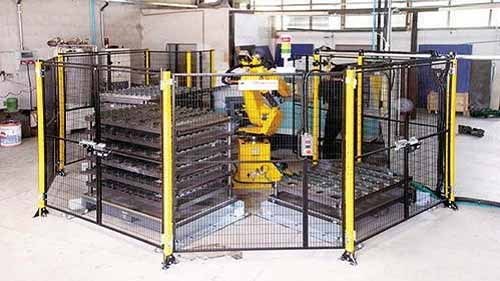
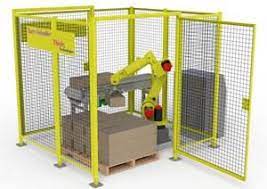
Key criteria for the selection of industrial bellows
To guarantee effective protection without altering the kinematics of the machine, a robotic bellows must meet the following technical specifications:
- Controlled flexibility: Ability to compress and extend without exerting opposing forces on the actuators or joints of the robot.
- Chemical and thermal resistance: Direct compatibility between the base textile of the bellows and the aggressive agents of the operating environment.
- Geometry adapted to the shaft: Conical, cylindrical, articulated or segmented designs developed according to the work envelope of the specific model.
- Sealed fixing systems: Clamps, flanges or technical closures that prevent the filtration of particles through the mounting interfaces.
- Optimized mass: Lightweight structures so as not to alter the moment of inertia or the payload capacity of the robot.
Breakdown prevention and operational continuity
The implementation of protective covers and bellows directly addresses the factors that cause unplanned production line downtime:
● Prevents loss of precision in articulated axes caused by premature wear of guides and bearings.
● Eliminates vibrations caused by debris accumulation on moving parts.
● Protects hoses, data cables, and connectors against continuous friction.
● Prevents intermittent failures in sensors and machine vision systems caused by dirt accumulation.
● Minimizes corrective maintenance costs and extends scheduled service intervals.
The Lluis Creus Solution: Tailor-made solutions backed by 150 years of experience
A standard bellows unit rarely meets the demands of a robot operating under critical conditions. The difference between temporary protection and a durable component lies in a design tailored to specific kinematics and operating environments.
At Lluis Creus, we develop custom solutions based on the “Smart Protection” concept, combining technical expertise with deep material knowledge:
● Custom design and engineering: We develop bellows tailored to the geometry of each robotic arm, articulated axis, or working envelope. We analyze travel paths, acceleration, and friction points to prevent deformation and dynamic interference.
● Technical material selection: Depending on process requirements, we use technical fabrics with special coatings, industrial leather, or materials with high thermal and chemical resistance to maximize durability against abrasion and cuts.
● High-precision waterjet cutting: We use waterjet cutting technology to shape each component to strict tolerances, ensuring perfect assembly and mounting.
● ISO 9001:2015 certified manufacturing: All design and production processes adhere to rigorous quality management standards to guarantee repeatability, reliability, and rapid response for spare parts.
● Multidisciplinary expertise: Our 150 years of experience in industrial protection allow us to provide expert guidance for every project, ensuring the cover or bellows integrates seamlessly without affecting the robot’s payload or speed.
If you are looking to optimize the uptime of your robotic cells and eliminate unplanned downtime caused by axis contamination, Lluis Creus develops the precise solution for every application.