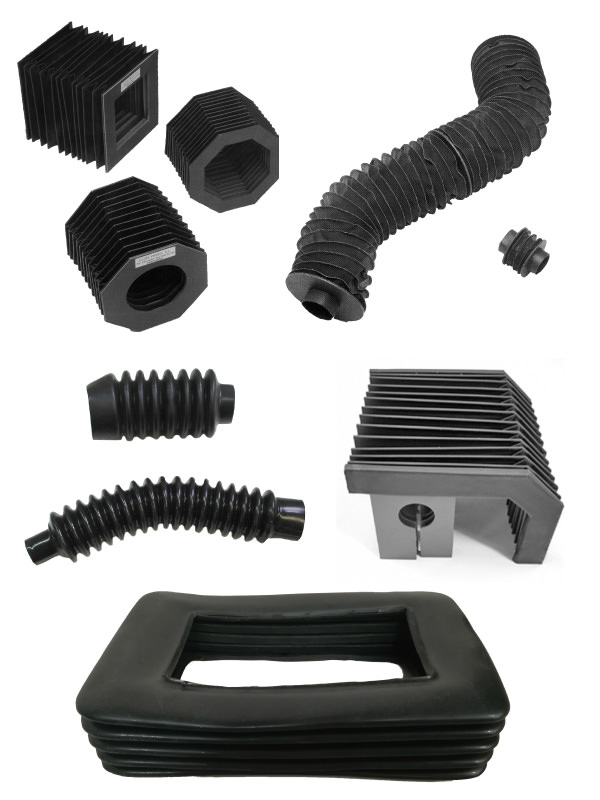

These are questions every maintenance manager should ask themselves before choosing a protective guard for industrial machinery.
In industry, choosing a bellows is often treated as a simple purchase: measure, order, and install. However, when analyzing how these guards influence equipment reliability, questions arise that are rarely asked and explain why some machines run cleanly and stably… while others don’t.
Below, we present a different format: frequently asked questions with clear answers, designed to help any maintenance, production, or engineering manager assess whether they are truly using the right protective guard for their industrial machine.
1. “If a bellows is new, why does dirt sometimes still get in?”
Because a bellows alone doesn’t guarantee a watertight seal. The protection of industrial machinery depends as much on the material as on the sealing, the closures, the geometry, and how the movement compresses or extends that protection.
A bellows may be new, but if:
- the lip doesn’t make proper contact,
- the geometry doesn’t follow the movement,
- or there’s a minimal opening at the ends,
dirt will find a way in. A new bellows doesn’t always mean an effective bellows.
2. “Does the bellows’ lifespan depend on the material?”
Only partially. The material does play a role, but what matters most is the compatibility between the material and the actual environment.
For example:
- An abrasion-resistant fabric is unsuitable for environments with aggressive coolant.
- A bellows designed for fine dust can fail in the presence of hot shavings.
- A high-temperature bellows may be overkill (and expensive) for soft-positioning shafts.
In industrial machinery guards, the key is not the most expensive material, but the right one.
3. “Why do some bellows always break at the same point?”
Because they are being subjected to repetitive stress at that exact spot.
The typical causes (all observable on the shop floor) are:
- a fold working under tension,
- a micro-collision with an edge,
- constant chip or liquid ejection,
- localized vibration.
As long as this external factor exists, an identical bellows will fail again. It’s not a defect: it’s a symptom.
4. “Is a standard bellows sufficient for a complex machine?”
In most cases, no.
A standard bellows is designed to be generic, not to fit your machine.
These are common limitations:
- It doesn’t fit the actual geometry exactly.
- The folds aren’t designed for that specific travel.
- The material isn’t adapted to the process residue.
- The shaft speed or acceleration exceeds the capacity of the standard bellows.
- The side seal is not compatible with the machine.
A standard bellows provides protection under mild conditions.
For demanding environments, the protection is insufficient.
5. “What signs indicate I need different protection?”
Here’s a simple checklist that works for any plant:
- Is there always dirt in the same spot?
- Does the bellows accumulate shine or uneven wear?
- Do the folds not fold symmetrically?
- Do the sensors fail for no apparent electrical reason?
- Has the operator patched it (cable, tape, small metal plate)?
- Is the bellows lasting less now than it did a few months ago?
- Is there moisture trapped inside the bellows?
If you answer “yes” to two or more, the industrial machine guard is not working correctly.
6. “Can I improve performance without changing the entire guard?”
Yes. And it’s more common than you might think.
In many cases, it’s enough to:
- Reinforce a specific area.
- Improve the closure.
- Modify the shape of the most exposed fold.
- Adjust the fastening.
It’s not always necessary to redesign the entire bellows, but rather to adapt it to the cause of the problem.
7. “How do I know if I need a custom bellows?”
The answer usually lies in one of these situations:
- The machine operates with hot or abrasive chips.
- The bellows is constantly exposed to fluid.
- The available space is very limited.
- The travel distance is long or has complex angles.
- Downtime due to dirt is frequent.
- The standard bellows has already failed several times.
When these factors combine, standard industrial machine guards are no longer sufficient.
Conclusion
Bellows and industrial machine guards don’t fail by chance. They fail when they are not aligned with the environment, the movement, or the actual production rate.
Asking the right questions allows you to determine if the problem lies with the bellows… or with the choice of bellows.
And that makes all the difference between a stable machine and one that requires constant maintenance.